A tropical botanical mural can make a room feel like a view, or like an enclosure. The difference isn't taste, it's scale, depth and how much empty space you leave the leaves. Here's how to choose a jungle wall that calms a Thai home instead of shouting at it.
There's an hour in every Bangkok afternoon when the light goes flat and white, and the leaves outside the window look as though they've been cut from paper. That's the light most Thai homes actually live in. A tropical botanical mural doesn't fight it. It was practically drawn for it.
Which is why a jungle wall reads differently here than it does in a London terrace. Bringing the garden indoors isn't an imported idea in Thailand; it's what the old houses always did, with wide eaves and a courtyard you walked through rather than looked at. Air-conditioning closed most of that away. A botanical wall quietly reopens it.
So let's talk about how to choose one — whether that's a large-format botanical wallpaper across a single wall, or a printed mural scaled to your exact dimensions. Because there are really only two kinds of jungle wall: the sort that overwhelms a room, and the sort that calms it.
Why a tropical print behaves differently in Thai light
Our sun sits high for most of the day, so walls in Bangkok get far less raking side-light than European ones. In a European room a low sun rakes across the wall and does half the work for you — modelling texture, making a flat print look sculptural.
Here, you mostly see a wall in flat ambient light. So I'd look for designs with contrast built into the artwork itself: tonal depth, dark pockets behind pale leaves, an obvious front and back. A design that leans on your room's light for its drama will look like a printed sheet by two in the afternoon.
The real difference: a jungle wall that overwhelms, and one that calms
Scale reads against viewing distance, not floor area
Most people measure the room and assume a small room needs a small print. Scale actually reads against how far back you can stand. A vast banana leaf three metres from the sofa is a graphic. The same leaf half a metre from your face in a narrow hallway is something you walk into.
So ask one question: from how far away will I usually see this? A bedroom wall is viewed from the doorway, so it can be generous. A corridor is only ever seen at arm's length, so it wants something quieter.
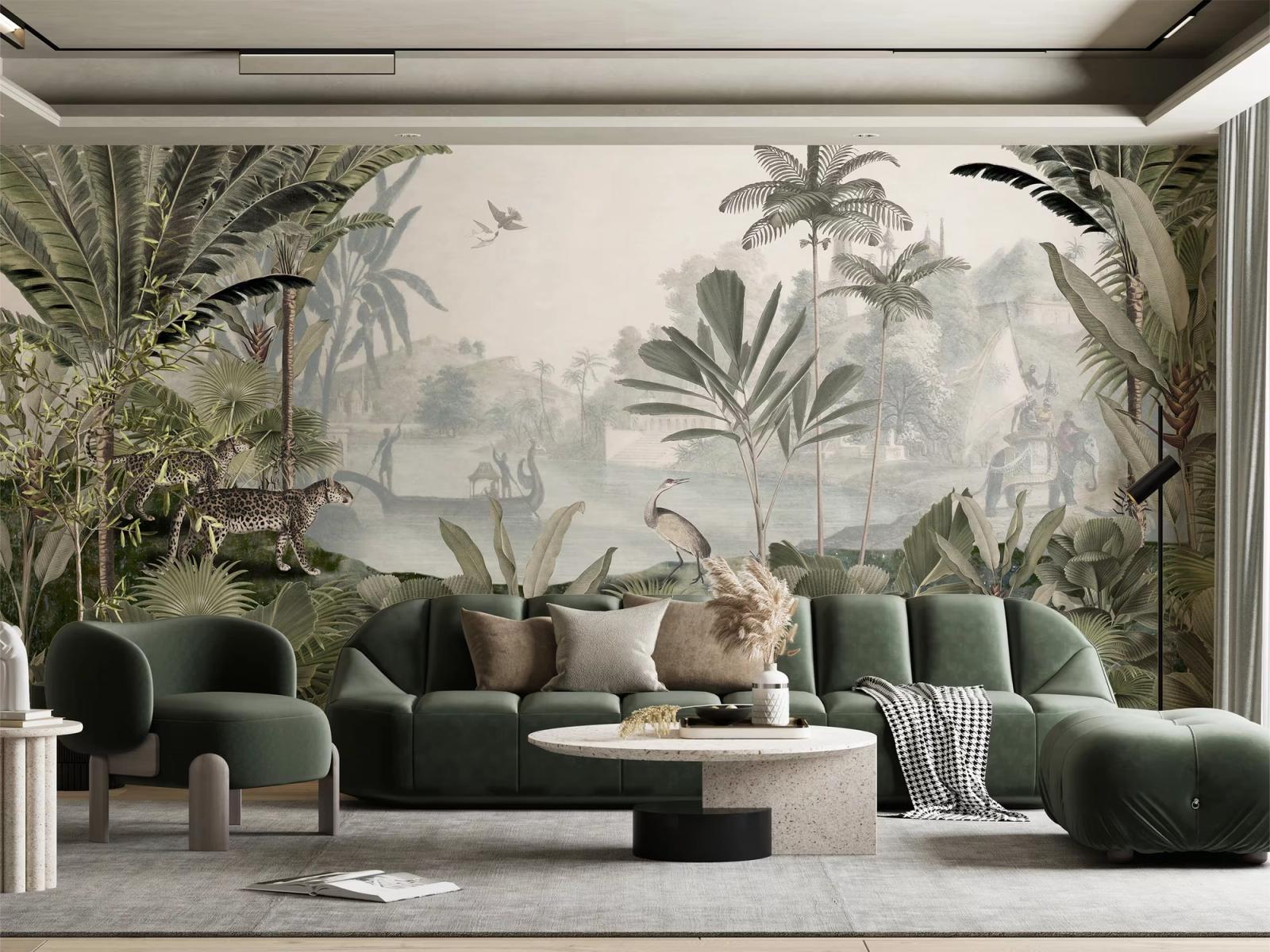
And one feature wall, not four. A jungle on every side of a room stops being a view and becomes an enclosure. Wild by Ohpopsi does the lush end beautifully: Palmera, with its trailing painterly palms, or Tropica, banana leaves softened into watercolour. It's because they're bold that they want one wall and three calm ones.
Depth is what makes a mural a view rather than a printed sheet
The botanicals that calm a room almost always have layers: something sharp in the foreground, something in the middle distance, something dissolving into haze behind. Your eye reads that as space. It settles, because it believes it's looking through the wall rather than at it.
Flat, evenly weighted foliage gives the eye nowhere to rest, so it reads busy however lovely the drawing. Toucan Toile and Hummingbird play the trick a different way: birds hidden inside a classic toile — the fine scenic print, usually drawn in a single colour, you'd know from an old French farmhouse — so you find them slowly instead of all at once.
Negative space is the whole secret
Dense foliage only becomes legible when there's emptiness around it. Gaps between the fronds, a pale ground showing through, a stretch of unbroken sky. Negative space is what stops a botanical reading as noise.
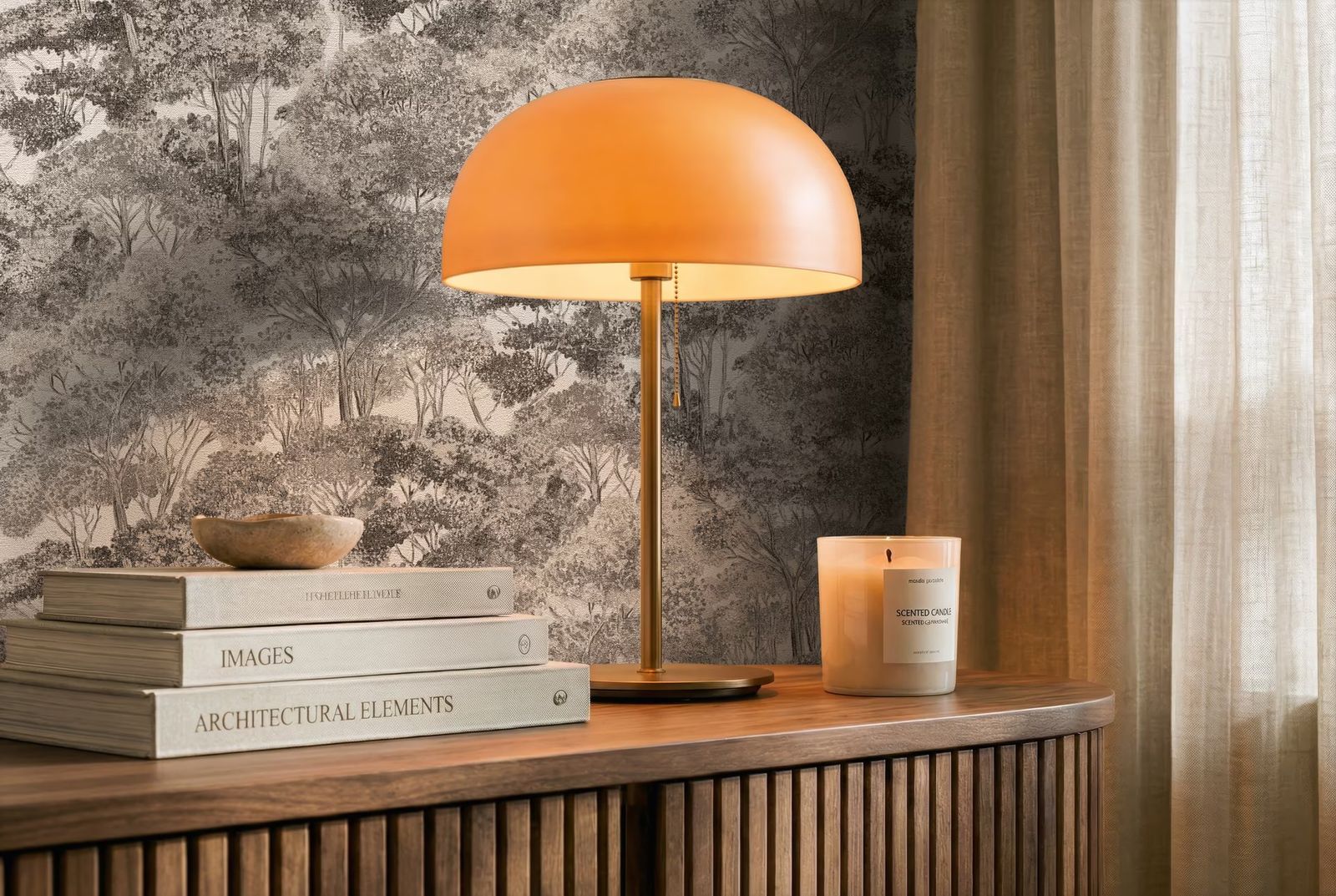
Which is where Jardin earns its place: a garden rather than a jungle, six hand-rendered designs with air in them. Summer Ferns is all watercolour movement. Mimosa Trail is a calm pen-and-ink stripe that behaves almost like a texture. Kalina is fine linear stems and seed heads. If "tropical" sounds like more than you want, this is where I'd start.
The dark-wall question, answered honestly
You'll read that a deep botanical ground makes a small room feel bigger. It's a lovely line, and it isn't settled fact.
The honest version: a dark wall flanked by light walls tends to advance. You read the boundary very clearly, which can make a room feel tighter rather than looser. The boundary only truly dissolves when the whole envelope goes dark, walls and ceiling and ideally the woodwork too.
So this is a choice between two good things, not a free upgrade. Deep jewel greens and inky grounds buy you atmosphere: an evening room, a dining wall, a bedroom like a cocoon. Soft rainforest greens on a pale ground buy you daylight and openness. Both are right. Decide which one you're actually after before you commit.
Choose the wall before you choose the design
The best wall is the unbroken one, not the one carved up by a door, an aircon unit and a TV bracket. A large-scale botanical needs its composition intact, and every interruption cuts a leaf in half.
Walk in and notice where your eye lands first. That's the wall worth spending the pattern on. Riches of Nature is built for that moment: Florence, a large-scale watercolour floral, or Lush Leaves, a tangle of untamed foliage that wants a wall to itself. These OHPOPSI collections sit at ฿440–560/sqm.
Pairing a botanical with the furniture you already own
The good news is you probably don't need to change much. Green botanicals are forgiving against warm wood, rattan and undyed linen. Teak, a rattan chair, an oatmeal sofa: the wall will make them look deliberate.
Two things to watch. If the sofa is already printed, let the wall win and keep the sofa plain. If the room is all glass and gloss, add one soft texture so the mural has something to rest against.
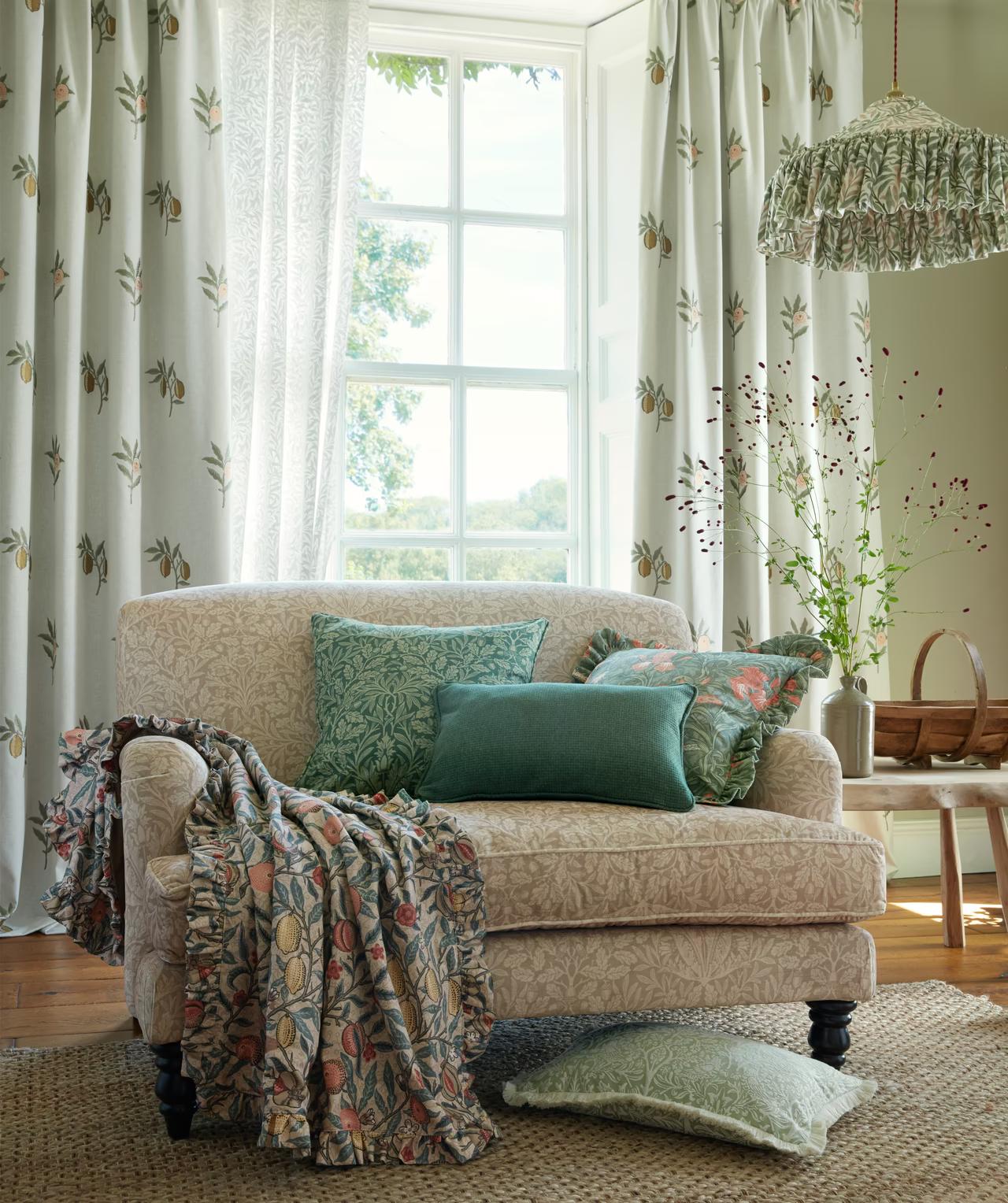
If you'd rather carry the botanical into the soft furnishings than double up on wall pattern, fabric is the graceful way to do it. Flora & Foliage Vol I from the Morris & Co. archive gives you woven leaves and cut velvets for curtains and upholstery, and Florian by Ashley Wilde is hand-painted botanicals on soft cotton, in bluebell, terracotta, kingfisher, sage and peony. Pull one colour out of the mural and repeat it once. Once is enough.
Where a large-format botanical actually works
In a condo
Choose one wall and be strict about it. Behind the bed is the safest and usually the loveliest: you don't sit staring at it, you wake up to it. Behind the sofa works too, as long as the sofa sits against a full, unbroken wall.
The two mistakes I see most often: papering the wall the television is on, since nothing survives a large black rectangle, and choosing an enormous print for a wall you can never stand more than two metres from. If you're renting, ask us about the removable options first — and there's more on what that involves in our guide to wallpaper in a rented Bangkok condo.
In a house
A house gives you the one thing a condo can't: distance. A stairwell, a double-height hallway, the wall you meet from the front door. These suit large-format botanicals, because you approach them, and the design resolves as you walk towards it.
A house also lets a mural be a destination rather than a backdrop. A dining room you only meet in the evening can take the deep, jewelled version happily. And when a wall is an awkward size, or you want a particular artwork scaled to fit it exactly, that's what our bespoke printed murals are for.
A few things people ask us
Can a tropical mural work in a small room?
Yes, if you get the viewing distance right and leave the pattern room to breathe. A mid-scale design like Arabella, tangled hand-drawn ferns, often suits a compact room better than one enormous leaf, because it stays legible close up.
Is an animal print a jungle too far?
Not necessarily. Treat it as texture. Animal Ikat, Zebra and Jungle Cheetah read as pattern rather than wildlife from across a room, which is why they sit more calmly on a single wall than you'd guess.
Come and stand in front of one
Botanicals are hard to judge on a screen. The only real test is holding a sample up in your own light, at the distance you'll live with it, and noticing whether the room goes quieter or louder.
Tell us about the wall you keep looking at, or book a design consultation in English or Thai, and we'll narrow it down together. There's no rush. The wall isn't going anywhere.