Non-woven describes the backing. PVC-free describes the surface — the layer in the room with your child. Here's how to read a children's wallpaper properly, from the spec sheet to the paste bucket, in a climate that condenses on the wall every April.
Search for non-toxic wallpaper for a kids' room in Bangkok and you'll find a hundred pages saying the same three things: non-woven, breathable, eco-friendly. Not one of those is a standard. They're words — and two of them don't even describe the part of the wallpaper your child will be breathing near.
So let's do this properly: what actually matters in a nursery, what to ask a supplier, and the one thing about Bangkok in April that changes the answer.
"Non-toxic" is a word, not a specification
There's no test a wallpaper passes to be called non-toxic. Same for chemical-free, baby class and anti-bacterial. They're sold hard and mean nothing in particular, which is why we don't use them about our own papers either.
What does exist is measurable: what a material is made of, what it gives off into the air of a small closed room, and where its paper came from. Three separate questions, three separate answers. Ask them one at a time and the marketing falls away rather quickly.
Non-woven is the backing. PVC-free is the surface
This is the correction almost nobody makes, and it's the whole article in one line.
Non-woven describes the backing — the fleece-like layer that goes against the wall. It's why a paper hangs easily (you paste the wall, not the paper) and why it comes off later in whole dry lengths instead of soggy shreds. Genuinely useful. But it says nothing at all about the printed face.
PVC-free describes the surface — the layer in the room with you.
A wallpaper can be non-woven-backed and vinyl-faced at the same time. Both things, on the same roll. So when a listing offers "non-woven" as its safety credential, it hasn't answered the question you asked. A Korean study of 332 wallpapers, published in the International Journal of Environmental Research and Public Health, found the PVC-coated ones emitted roughly seven times the total volatile organic compounds of paper-backed papers, and around sixteen times that of naturally coated ones. That gap sits on the surface, not the backing.
Which is exactly why a spec sheet worth reading states the two separately.
What Lilly & Luis actually says on the box
Lilly & Luis is AS Création's children's line, made in Germany under their d'eco banner, and it's the collection we reach for first when a client says nursery. Seventy-three designs: papers, eighteen full-height wall panels, nine borders, and fifteen watercolour plains matched to the prints so you're not hunting for a companion colour.
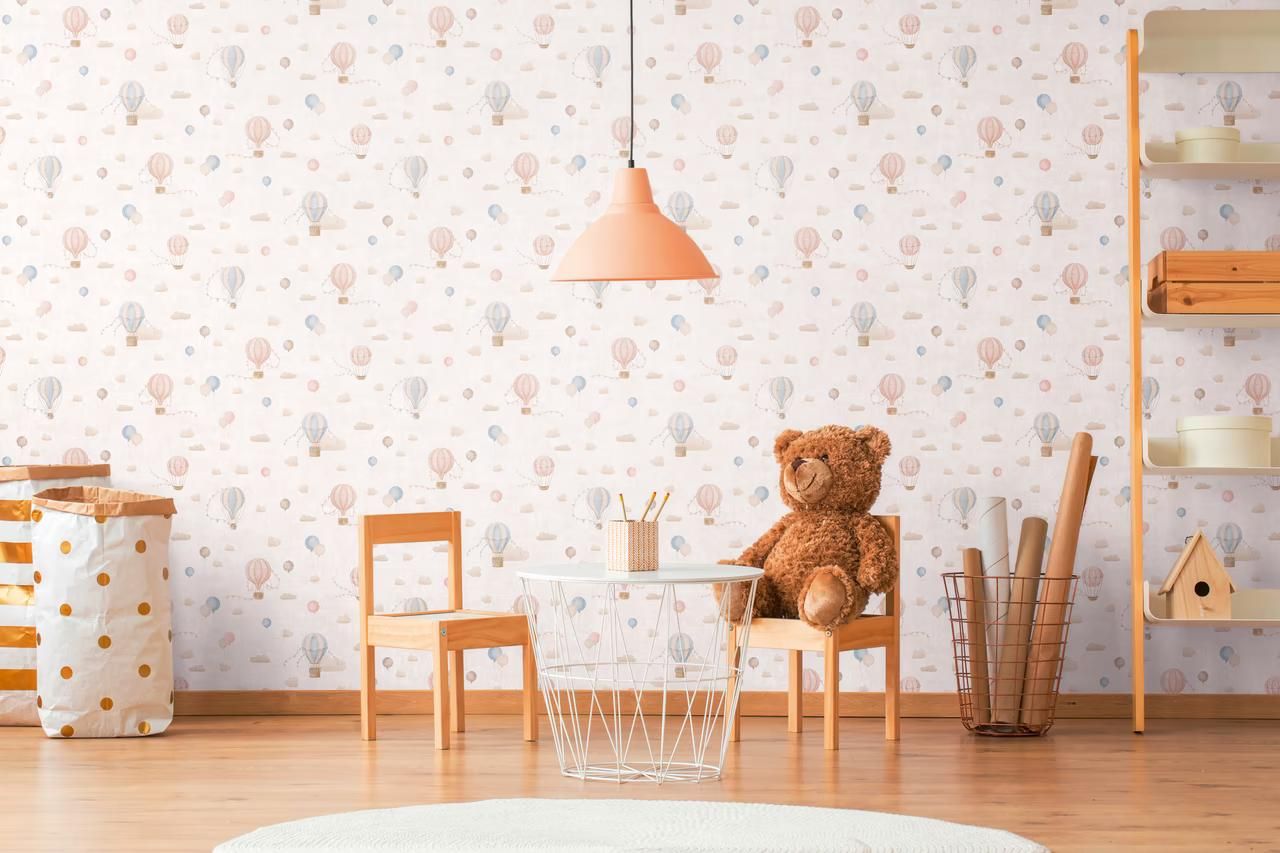
The drawing is soft — koalas asleep in eucalyptus, dinosaurs, mermaids, unicorns, balloons, clouds, a circus. Watercolour pastels rather than primary brights, which is a kinder thing to wake up to.
On the material, it says four specific, checkable things:
- Printed on a non-woven backing with no PVC, no solvents and no plasticisers
- FSC-certified paper
- Odourless inks
- Dry-strippable in whole lengths, when the dinosaurs have had their day
Notice the shape of that: things rather than adjectives, each one you could hold a supplier to. AS Création also states the range is intended for children's rooms — read that as the maker's own positioning, not a rating from anyone else.
Sizes, if you're measuring: papers come in 10.05 m × 53 cm rolls, panels are 1.59 m wide by 2.80 m high, borders run 5 m × 13 cm.
FSC is about trees, not air
Worth being blunt, because FSC gets mis-sold constantly. It certifies where the wood pulp came from and that the chain of custody held up — a good thing, and a real one.
It says nothing whatsoever about VOCs, inks or what the surface emits into a small bedroom. A wallpaper can be FSC-certified and vinyl-faced. If a salesperson offers FSC as the health answer, they've changed the subject.
The Bangkok part: April, dew point, and what grows behind a wall
Here's where the imported advice stops being useful. Every British or American guide assumes you'll open a window. In a Bangkok condo, you won't.
RISC, the research centre under MQDC, describes the failure mode neatly. On an April afternoon it's 36°C outside, the air conditioning is holding the room at 25–27°C, and the dew point sits around 28°C. The wall surface drops below dew point and condenses — a fogged window, but it's your wall. Any dust trapped behind the covering then has the moisture it needs, and fungal growth follows.
RISC's advice is unglamorous and correct: seal cracks and leaks before anything goes on the wall, use a moisture-resistant primer with anti-fungal properties, and choose an adhesive that is low-VOC and free of the additives that feed fungi.
Notice that none of that is about which wallpaper you chose. In this climate the preparation decides whether the wall survives; the paper only decides how it looks. Our own installation team preps before it papers, for exactly this reason.
The adhesive is the blind spot
If a paper is hung rather than self-adhesive, someone has to paste it — and the paste is a separate material with its own emissions, usually bought locally by whoever is doing the fitting. It gets discussed almost nowhere.
Which is odd, given it's the one component that arrives wet and dries in the room. When you're specifying a nursery, the adhesive belongs in the conversation alongside the paper: low-VOC, and without the fungus-feeding extras RISC warns about. It's also the plainest reason to care who is standing on the ladder.
Airing a room that has no windows open
A nursery is a small volume, kept shut, and air-conditioned on recirculation. Low dilution, low air-change rate. So the honest method matters more than a number, and you'll see plenty of confident numbers online that nobody has measured.
What we'd actually do: ventilate while the work happens and for a good stretch afterwards — windows and door open, fan running, AC off, so you're moving fresh air rather than the same air. Then judge by smell. A room that still reads of adhesive isn't ready, whatever the calendar says. Your nose is a reasonable instrument.
Questions parents actually ask
Is wallpaper safe for a baby's room?
The right ones are, and they're easy to identify: PVC-free surface, stated plainly and separately from the backing, plus a low-VOC adhesive. It's the vinyl face and the wet paste that carry the risk, not the idea of wallpaper.
How soon can they sleep in there?
Air it thoroughly — windows open, fan on, AC off — and use your nose. Odourless inks mean there's less to wait out than with a solvent-printed paper, but no honest supplier can hand you a fixed number of hours for a room they haven't stood in. Judge the room, not the calendar.
Will it go mouldy in Bangkok?
Only if the wall was damp or dirty before it was covered, or the surface keeps dropping below dew point. Fix the leak, prime properly, choose the right paste. A well-prepared wall doesn't grow anything.
Is the glue safe?
Ask. It's a fair question and a good supplier will answer it without shuffling. If nobody can tell you what's in the paste, that tells you something too.
If you'd rather have a mural
Rolls, panels and borders are one route. A printed mural is the other — Kikki Belle for nature scenes with several colourways per design, Oliver Robins for softer nursery work with more ground showing, made to recede at night, or When I Grow Up by OHPOPSI, hand-illustrated, candy-bright and made in the UK on a non-woven ground. For how a children's mural ages as the child does, our piece on what's actually on the wall in a kids' bedroom is the companion to this one.
Costs live in our wallpaper cost guide, where they stay current.
Come and look at it
Samples help more than screens do — pastels especially, which shift a great deal under Bangkok daylight and again under a warm bulb. Bring your dimensions, or a few photos and a rough idea of where the cot goes, and we'll work through it with you in English or Thai. The consultation is free, always.
Tell us about the room and we'll take it from there.