Wave, pinch pleat, pencil pleat, eyelet, Roman blind — the interesting question isn't which you like, it's which your cloth wants. How to pair fabric to style, and how ordering works.
Most guides to curtain styles begin with the styles. Let's begin with the cloth.
The curtain styles Bangkok workrooms make most often are the same short list you'll find anywhere: wave, pinch pleat, pencil pleat, eyelet, a Roman blind. What nobody tells you is which of them your fabric actually wants — and the fabric has opinions. A pleat and a large printed floral are quietly at war.
So find a cloth you love in the fabric library — our guide to where to buy designer fabric in Bangkok is the place to start if the books are new to you — then read on for its style.
The pleat eats the pattern
A pinch pleat gathers cloth at fixed intervals and buries whatever sits inside the fold. Your pattern survives on the flat faces between pleats and nowhere else: lovely for a small sprig, cruel to a big one. A pencil pleat is stricter still: the gather is continuous, so there are no flat faces at all. A wave shows more, because the cloth curves rather than folds. A Roman blind shows most, being simply flat when it's down.
A repeat, if the word is new, is the distance before a pattern starts again. And a big one quietly costs you cloth: every width must be cut to a whole number of repeats, so the pattern lines up with its neighbour. Say a 260 cm drop: add roughly 30 cm for hems and header and you need a 290 cm cut. On a cloth with a 53 cm repeat, 290 ÷ 53 = 5.47, which rounds up to six repeats — a 318 cm cut. That's 28 cm binned on every width, and a wide window needs several. A plain wastes none of it.
Where the seams land is a style decision too
Fabric comes on rolls around 137–145 cm wide, so a three-metre window needs several widths joined. A pinch pleat can hide a seam inside a fold; a wave leaves it in full view down a curve.
Sheers are the hard case: every join shows against the light. That's why a wide-width sheer — cloth woven far wider than the usual 140 cm — is turned sideways and run as one seamless piece across a whole wall. The Forager from Morris & Co includes one. Ask for a transparent heading tape, too — that's the stiffened band sewn along the top that the hooks or gliders hang from, and a coloured one shows straight through.
Sheers, plains and light weaves: wave, almost always
The S-fold, or wave — ม่านลอน — has no sewn pleats: the cloth runs in continuous, even S-curves from a track built for it, with the gliders spaced 60 mm or 80 mm apart (80 mm gives deeper waves, fewer of them). It's the natural heading for anything light, and it carries a large pattern as one continuous undulation rather than chopping it into columns.
Its honest weakness: wave panels can't overlap where they meet, so a closed pair leaks light down the centre and over the top, even in blackout cloth. What goes behind the face fabric is a decision of its own, covered in our guide to blackout, dim-out and sheer linings.
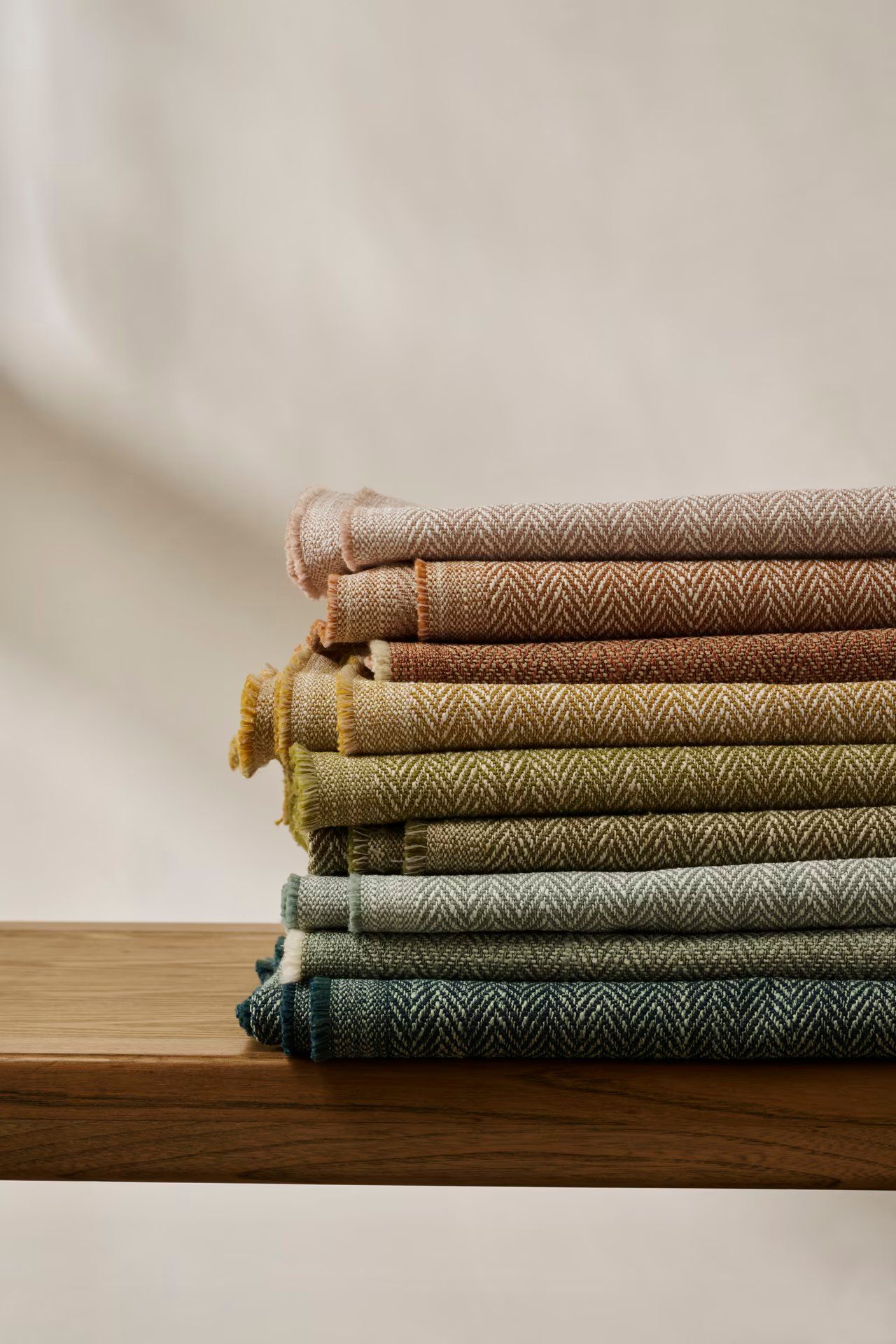
With plains and textured weaves it's a free choice. Aubrey is the case in point: a recycled-polyester herringbone, 140 cm wide, in 33 colourways, rated at 50,000 Martindale rubs — the standard rub test for wear — and so tough enough for hotel and office work. No motif to bury, no repeat to match. Florian gives you the same freedom in its stripes and woven textures at 138–140 cm, with hand-painted florals in the same book if you'd rather have pattern. Wave for modern, pinch pleat for tailored — and a stripe is one of the few patterns a fold flatters.
A large print wants to hang flat
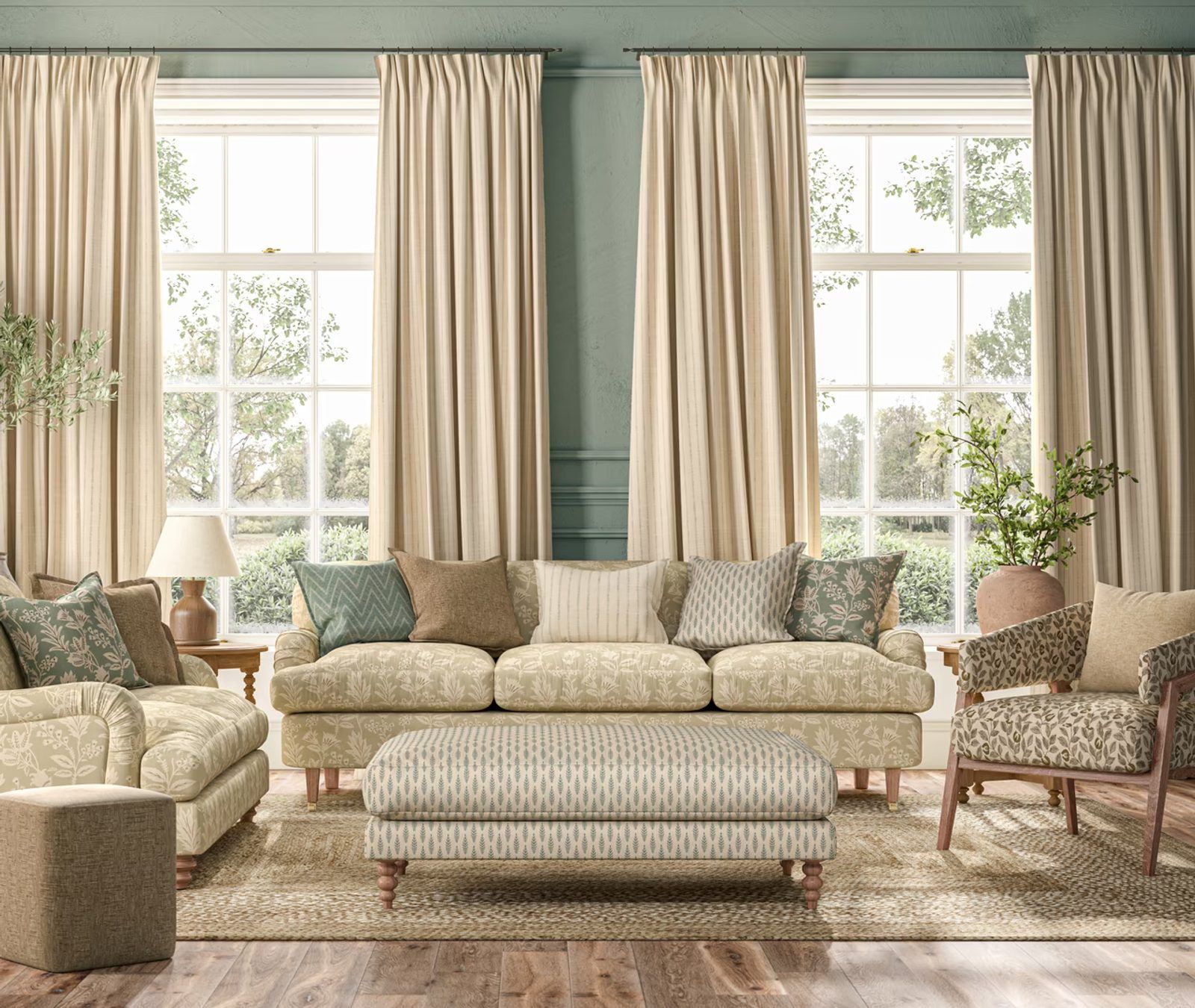
Arden is watercolour floral at its most generous: 137–138 cm, cotton or cotton-linen, made for drapery. Flora & Foliage Vol I poses the same happy problem — botanical prints, woven leaves and plush cut velvets at 136–140 cm.
Both deserve to be seen whole, so the order runs: a Roman blind (ม่านพับ, literally "folding curtain" — not the roller blind, which is ม่านม้วน), then a wave, then a pinch pleat, which gives you the pattern on the flat faces. A pencil pleat will gather your beautiful floral into a rope.
Blinds want a medium-weight, non-stretch cloth, and Thai workrooms rightly say they suit narrower windows: joining two panels across a wide one leaves a line down the middle of your uninterrupted pattern.
Weight wants structure
ม่านจีบ — the pinch pleat — is counted here by finger: 3 จีบ, 2 จีบ, 1 จีบ, triple being the Thai default. On naming: in English the triple pinch is often called a French pleat, so two quotations describing different headings may mean the same one.
This is the heading for cloth with body. Toulouse makes the case: Indienne prints over textured weaves and jacquards, 138–145 cm, warm earthy tones, with a hard-wearing upholstery plain (Lois) in the book. Weight wants holding in vertical columns, not left to drift. Cut velvet asks for the same, plus one thing more: the pile must run the same way on every panel, or two curtains from one roll will read as two colours. A heavy pile wants a pinch or pencil heading, never eyelets. (A goblet pleat, the dressier cousin, needs a stiffener in every cup, and it won't stack back neatly — that's the trade for the drama.) The pencil pleat is continuous narrow gathers, adjustable at the tape; there's no settled Thai retail term for it, so Thai shops specify ม่านจีบ by finger-count instead.
The casual counterpoint: eyelet
ม่านตาไก่ — ตาไก่ means "chicken eye", which is the ring. Rings threaded onto a pole or rail, deep even folds, the least cloth of the mainstream headings. Thai retailers lead with the practical argument: eyelet curtains come down and go in the wash with no hooks to unpick. Two caveats. Light enters over the top through the ring gaps, so it isn't for a room you need dark. And practice diverges — British makers treat eyelet as pole-only, while Thai and American workrooms happily run it on a track.
Three Bangkok things to check before you fall for a style
- The ceiling recess decides more than you'd expect. The Thai curtain recess (หลุมฝ้า, or ดรอปฝ้า) is usually built at about 20 cm during fit-out, long before anyone chooses a curtain — and a two-layer wave set wants nearer 28 cm. That arrangement, ผ้าม่าน 2 ชั้น on a double track (ราง 2 ชั้น), is near-universal here, and the local convention reverses the European one: the sheer (ม่านโปร่ง) hangs nearest the glass, the opaque (ม่านทึบ) room-side.
- Dust season is real. From December to March the city gets dusty, and Thai retailers say it themselves: pleats collect dust and are the least practical heading to take down and wash, while wave and eyelet panels come off easily. Not a verdict against pleats — a trade-off against how good they look.
- Cleaning shrinks curtains. Dry cleaning can take up to about 5% off a curtain — around 10 cm on a full-length pair, and on a 2.6 m condo drop, a hem that no longer reaches the floor. Some Bangkok cleaners won't take coated blackout cloth at all.
How ordering works, in three steps
- Measure. Width, drop, fixing surface, whatever's in the way. The on-site measuring visit carries a ฿1,000 fee, credited in full when you order; the conversation before it — a design consultation — is always free.
- Select. Fabric, lining, heading — in that order, because the first narrows the third.
- Make and hang. Made to your measurements, then hung by our own team. Nothing off a shelf.
Our curtains and soft furnishings service covers all three.
Quick answers
Which style shows off a big pattern best?
A Roman blind, because it hangs flat. Then wave, then pinch pleat; pencil pleat last, its continuous gather leaving no flat surface at all.
Do I have to choose the fabric first?
It's the easier way round: weight, width and repeat narrow the headings for you. Starting from a style can rule out the cloth you wanted.
Come and see how it hangs
Fabric photographs badly. Weight, drape and the way a colour behaves in Bangkok daylight only make sense in person — which is what the Ashley Wilde and Morris & Co books in our showroom are for. We're in Wang Thonglang, just off Lat Phrao — bring a photo of the window and take as long as you like with the books.
Or begin from the sofa: tell us about your windows, in English or Thai.